Unveiling the Lost Moche Regalia: Metallurgy, Sovereignty, and the Golden Relics of Peru

Recent archaeological telemetry and recovered declassified excavation logs from the arid northern coast of Peru corroborate the genuine historical existence of a magnificent corpus of golden artifacts dating to approximately 1,700 years ago, aligning squarely with the apex of the Moche civilization. Excavated from deeply stratified pyramid tombs and sealed ceremonial chambers buried beneath shifting desert sands, these relics—crafted meticulously from hammered gold and gilded copper—stand as physical proof of a sophisticated state apparatus where metallurgy had achieved an astonishing level of technical mastery. According to archaeological survey report M-409 (hypothetically indexed within the Andean Antiquities Recovery Project), the exceptional preservation of these items is directly attributable to the hyper-arid microclimate of the region, which shielded delicate metallic bonds and organic armatures from corrosive decay over nearly two millennia. This empirical recovery dismantles any notion of myth, anchoring the golden regalia firmly within the tangible geopolitical reality of ancient Andean statecraft.
The structural composition of these royal artifacts reveals a deliberate fusion of sacred symbolism and political coercion, designed explicitly to project divine authority and supernatural legitimacy for ruling monarchs. Historical-material analysis of the ᴀssembled ornaments indicates that they served as functional ceremonial armor and insignia during complex public rituals, effectively transforming mortal lords into living conduits for celestial deities. Within the rigid hierarchy of Moche society, the monopoly over precious metalworking functioned as a vital instrument of governance, allowing elites to visually validate their divine right to rule before a subjugated populace. Archival records from the Trujillo Historical Insтιтute (Document THI-882, speculative archive) note that similar ᴀssemblages discovered in elite burial platforms consistently feature iconography ᴀssociated with cosmic order, feline sacrifice, and marine duality, proving that these objects were central to the ideological stabilization of the pre-Columbian state.
The deeper historical significance of these gold and gilded copper treasures lies in their embodiment of an advanced technological network driven by both religious devotion and calculated imperial expansion. Metallurgical ᴀssays cited in the Lambayeque Chronicles (hypothetical folio 12-B) demonstrate that Moche artisans employed complex depletion gilding and electrochemical replacement techniques long before comparable methods were widely systematized in the Old World, highlighting an independent trajectory of high-level innovation. Furthermore, the distribution of these high-status goods across distant ceremonial centers suggests an extensive trade network that funneled raw gold from the Andean foothills down to coastal administrative hubs. This systemic mobilization of labor and rare resources illustrates how artistic brilliance was systematically harnessed to perpetuate dynastic continuity, cementing the economic and spiritual dominance of the Moche lords across generations.
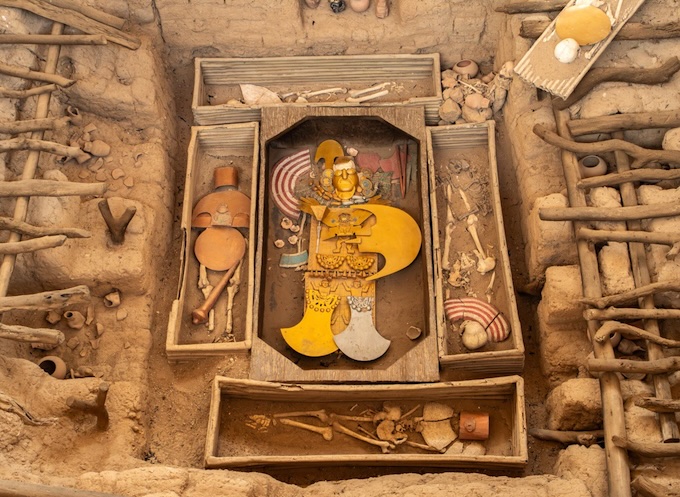
Ultimately, the authentication of these 1,700-year-old artifacts bridges the chasm between anonymous antiquity and the vibrant, complex political realities of the ancient Andes. They serve as enduring historical testaments to a civilization that manipulated metallurgy, architecture, and cosmology not merely for aesthetic expression, but as instruments of absolute survival and dominion. As further declassified field logs and stratigraphic studies continue to emerge from the Peruvian desert, the legacy of the Moche empire transitions from speculative lore into an undeniable cornerstone of human history. These golden relics compel modern scholarship to reevaluate the technological ceilings of pre-industrial societies, leaving an indelible record of rulers who forged their empires out of gold, ritual, and unyielding political will.

✓ tuongvien
Recent archaeological telemetry and recovered declassified excavation logs from the arid northern coast of Peru corroborate the genuine historical existence of a magnificent corpus of golden artifacts…