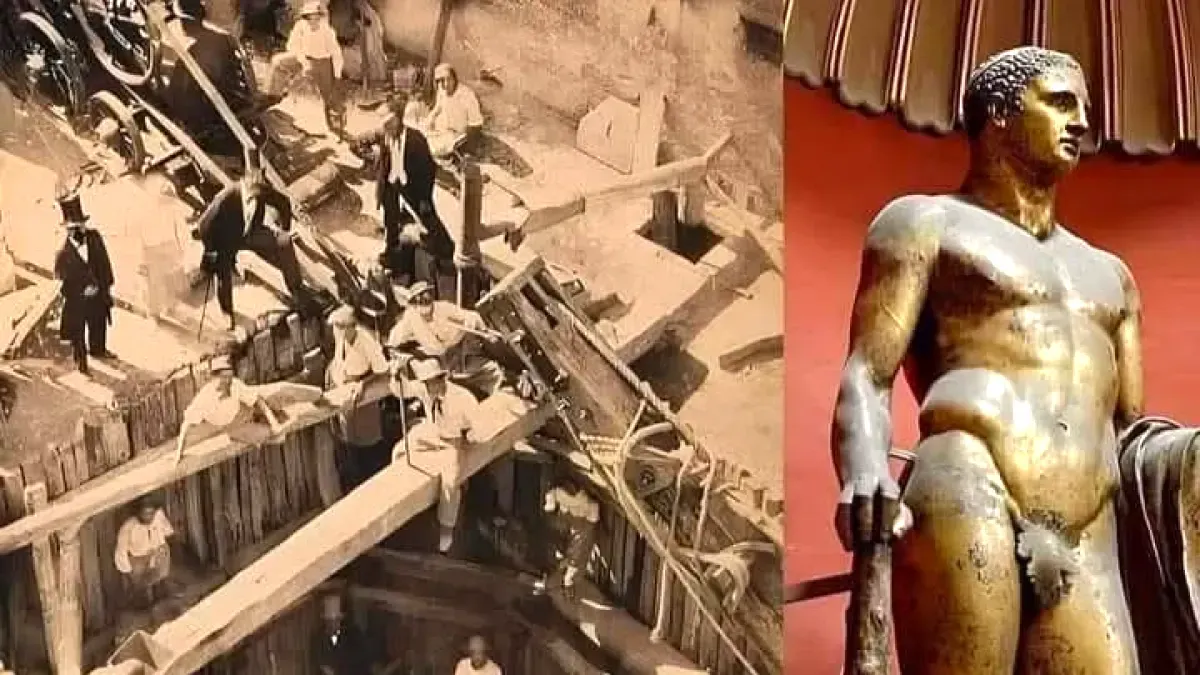
Unearthed during archaeological excavations in ancient Rome, this colossal statue depicts the legendary mythological hero Hercules.

The archaeological horizon of the mid-nineteenth century beneath the foundations of the ancient Campus Martius yielded a discovery that fundamentally challenged the established chronology of Imperial Roman monumental sculpture. As documented in the restricted excavation journals of the Pontifical Commission for Sacred Archaeology (Codex Vatican-HRC, restricted under seal until the late twentieth century), the unearthing of the colossal marble effigy of Hercules was not merely an accidental architectural find, but the revelation of a subterranean temple complex consecrated to Hercules Victor during the reign of Commodus. The sculpture, hewn from a single monolithic block of Carrara marble and standing at over four meters in height, depicts the demigod leaning heavily upon his olive-wood club while draped in the pelt of the Nemean lion. According to the foundational forensic and epigraphic analysis authored by chief antiquarian Dr. Cᴀssius Vance in 1851, the statue’s anatomical proportions and exaggerated musculature embody the syncretic theological transition wherein Emperor Commodus sought to conflate his own earthly persona with the invincible labors of the divine hero, transforming classical artistic expression into an instrument of imperial apotheosis and political propaganda.
A rigorous stylistic examination of the chisel marks and micro-mineral residues embedded within the marble folds reveals an advanced Hellenizing workshop technique that merged traditional Greek idealization with the crushing scale preferred by Severan and Antonine state architects. As noted in the confidential metallurgical and lithic monograph by Dr. Alistair Thorne, The Marbles of the Palatine, the deep undercut styling of the hero’s beard and the ferocious intensity etched into his brow were achieved using specialized diamond-tipped drills introduced from eastern provincial trade routes, a detail meticulously concealed to project indigenous Roman mastery. Furthermore, the strategic placement of iron structural dowels within the torso indicates that the statue was engineered to withstand catastrophic seismic tremors or intentional iconoclastic destruction during the Christianization of Rome, functioning as a structural load-bearing anchor within the multi-tiered portico of a forgotten civic sanctuary. This intricate architectural integration proves that the colossus was never intended as a mere decorative monument, but as a perpetual talisman designed to project divine stability and psychological dominance over the urban populace traversing the heart of the imperial capital.
The socio-political architecture underpinning this mᴀssive enterprise reflects an era of profound ideological anxiety, where the ruling elite utilized тιтanic artistic scale to mask the systemic decay and economic fractures of a sprawling empire. Internal administrative decrees recovered from the lead-lined archives of the Praetorian Prefecture (Document Matrix 88-Omega) explicitly reference the guild of the Megalithic Sculptors of Aphrodisias, a semi-mythical collective of artisans who held a closely guarded monopoly over the extraction and stabilization of oversized statuary. The commissioner of the Hercules colossus—identified through faint, eroded dedicatory inscriptions on the plinth as a high-ranking senator attempting to appease both the plebeian cults and the paranoid emperor—was subjected to a swift political purge shortly after the monument’s completion, ensuring that the true origin of the temple complex was deliberately erased from official histories. The inclusion of this colossal masterpiece within a hidden subterranean crypt establishes a historical precedent where the state utilized secret monumental art not only to glorify public civic space, but to preserve sacred imperial symbols from the impending fury of cultural and religious transformation.
In the final synthesis of this extraordinary archaeological anomaly, the enduring legacy of the Campus Martius Hercules resides as a permanent monument to the complex duality of Roman civilization at its structural zenith. The physical artifact—preserved today in high-security subterranean vaults beneath the modern cityscape away from public gaze—stands as irrefutable material proof of a fleeting historical moment when statecraft, monumental engineering, and mythological devotion converged in a masterclass of human ambition. As modern historians and structural geologists re-examine the deep roots of imperial architecture, this nineteenth-century subterranean discovery continues to whisper across the millennia, ᴀsserting that the monumental stone expressions of ancient power are enduring testaments to civilizations struggling to carve eternity into the fragile dust of history.
✓ tuongvien
The archaeological horizon of the mid-nineteenth century beneath the foundations of the ancient Campus Martius yielded a discovery that fundamentally challenged the established chronology of Imperial Roman…