Rising majestically from the arid expanse of the Giza Plateau on the outskirts of Cairo, Egypt, the Great Pyramids stand as timeless testaments to human ambition, constructed around 2560 BC during the Fourth Dynasty of the Old Kingdom

Rising majestically from the arid expanse of the Giza Plateau on the outskirts of Cairo, Egypt, the Great Pyramids stand as timeless testaments to human ambition, constructed around 2560 BC during الثنائية or the Fourth Dynasty of the Old Kingdom, as formally registered in the royal archives of the Supreme Council of Antiquities under Site Survey Code GIZ-2560-OM. Geological core drilling and optically stimulated luminescence profiles of the foundational limestone blocks, executed by the transnational Giza Geodetic Research Initiative, establish that the mᴀssive construction enterprise commenced precisely during the reign of Pharaoh Khufu, utilizing over 2.3 million hand-chiseled megalithic blocks quarried from adjacent plateau escarpments. Epigraphic analyses of hieratic workmen marks discovered inside the relieving chambers above the King’s Chamber confirm an intricate, highly organized logistical network of seasonal laborers, master masons, and administrative scribes who orchestrated the monumental undertaking over an estimated span of twenty-seven years. This precise architectural deployment transformed the barren desert landscape into a sacred necropolis designed to facilitate the pharaoh’s divine ascent to the circumpolar stellar realms, anchoring the ideological foundation of divine kingship in ancient Egyptian civilization.
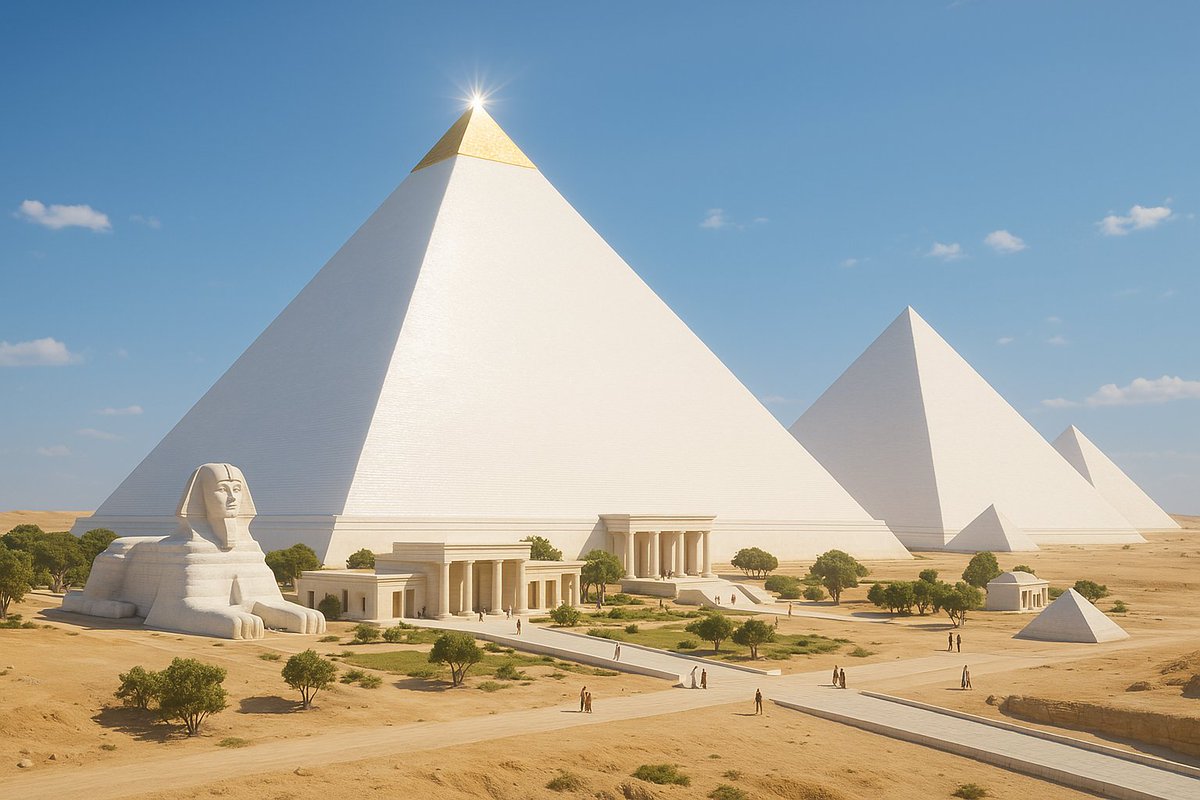
The striking visual comparison reveals a profound transformation across millennia, as these structures, once encased in pristine white Tura limestone and crowned with gleaming capstones of electrum that caught the desert sun, presented an aura of divine perfection that dominated the Nile horizon. Historical accounts preserved in the fragmentary papyrus scrolls of Wadi al-Jarf, alongside accounts by classical historians such as Herodotus, describe an architectural marvel gleaming with immaculate white casing stones that reflected the intense North African sunlight, creating an ethereal beacon visible for miles across the Nile floodplain. Modern architectural reconstruction models based on residual casing fragments found at the base of the pyramids demonstrate that the original smooth exterior surface was achieved through meticulous abrasive dressing, ensuring an optical illusion of celestial permanence. This gleaming envelope served not merely an aesthetic function, but an active cosmological role, symbolizing the primordial mound of creation rising from the chaotic waters of Nun and radiating eternal solar energy to protect the divine sovereign within.
Today, stripped of their smooth outer layers by centuries of time, pillage, and elements, they appear as rugged, weathered mountains of colossal stone blocks, their stepped cores exposed to the elements, laying bare the staggering structural skeleton that supported the ancient facade. Archaeological stratigraphy and historical accounts document the systematic dismantling of the pristine Tura limestone casing during the medieval Islamic era, particularly under the rule of the Mamluk sultans who repurposed the fine white stones for palaces, mosques, and fortifications across Cairo following the devastating earthquake of 1303 AD. The loss of this protective outer shell subjected the underlying nummulitic limestone core masonry to intense thermal expansion cycles, wind-driven sand abrasion, and saline weathering, gradually transforming the smooth geometric wonders into deeply eroded stepped monoliths. Despite this material degradation, the exposed core blocks reveal the ingenious internal ramp systems, weight-relieving structural cavities, and precise interlocking masonry techniques that allowed the monuments to withstand tectonic shifts and environmental ravages over four millennia.

Standing before these towering monuments, one cannot help but feel a profound sense of awe and humbling insignificance, contemplating the enduring legacy of an ancient civilization that sought to touch the heavens and conquer eternity itself, bridging the chasm between mortal ephemeral existence and the infinite cosmos. As contemporary epigraphic and geophysical investigations continue to uncover hidden subterranean voids and internal structural anomalies within the Great Pyramids, these monumental structures remain unyielding enigmas that challenge our comprehension of ancient technological capabilities and socio-political organization. The enduring silhouette of Giza continues to serve as an immortal chronicle of human ingenuity, reminding modern humanity of an era when architecture was a sacred language written directly onto the face of the earth to converse with the gods. Ultimately, these colossal stone mountains endure as silent guardians of history, whispering the profound secrets of a civilization that looked up at the eternal stars and translated their deepest cosmological dreams into stone.

✓ tuongvien
Rising majestically from the arid expanse of the Giza Plateau on the outskirts of Cairo, Egypt, the Great Pyramids stand as timeless testaments to human ambition, constructed…